


Enabling Data Literacy: 5 Ways a Data Catalog is Key

Enabling Data Literacy: 5 Ways a Data Catalog is Key

In today’s data-driven world, organizations from all industries are collecting vast amounts of data from various sources, including IoT, applications, and social media. This data explosion has created new opportunities for businesses to gain insights into their operations, customers, and markets. However, these opportunities can only be realized if organizations have a data-literate workforce that can understand and use data effectively.

Indeed, data literacy refers to the ability to read, understand, analyze, and interpret data. It is a crucial skill for individuals and organizations to stay competitive and make data-driven decisions. In fact, according to a recent study by Accenture, organizations that prioritize data literacy are more likely to be successful in their digital transformation initiatives.

To enable data literacy, organizations need to provide their employees with easy access to high-quality data that is well-organized, well-documented, and easy to use. This is where a data catalog comes in.

In this article, discover the 5 ways a data catalog enables successful data literacy in organizations.

A quick definition of data catalog


At Zeenea, we define a data catalog as being an organized inventory of an organization’s data ecosystem that provides a searchable interface to find, understand, and trust their data.

Indeed, created to unify all enterprise data, a data catalog enables data managers and users to improve productivity and efficiency when working with their data. In 2017, Gartner declared data catalogs as “the new black in data management and analytics”. And in “Augmented Data Catalogs: Now an Enterprise Must-Have for Data and Analytics Leaders” they state: “The demand for data catalogs is soaring as organizations continue to struggle with finding, inventorying and analyzing vastly distributed and diverse data assets.”

A data catalog is therefore a crucial component in an organization’s data literacy journey. Let’s see how.

#1 A Data Catalog centralizes all data into a single source of truth


A data catalog automatically collects and updates all enterprise data from across your various sources into a single repository to help create a comprehensive view of an organization’s data landscape. By indexing your organization’s metadata, data catalogs increase data visibility and enable data and business users to easily find their information across multiple systems.

This boosts data literacy for organizations as data catalogs help break down silos between different departments and teams by providing a single, searchable repository of all available data assets. Indeed, with a data catalog, no technical expertise is required to access and understand a company’s data ecosystem: organizations can easily collaborate and share their information assets in a single platform.

#2 A Data Catalog increases data knowledge via documentation capabilities


Data catalogs enable the increase of enterprise-wide data knowledge via the automation of documentation capabilities. By providing data producers with documentation features, users get descriptive information about their data assets, such as their purpose, usage, and relevance to business processes. With comprehensive documentation capabilities in a data catalog, data users can easily understand and use data assets, ultimately promoting data literacy across the organization.

By ensuring that documentation is accurate, consistent, and up-to-date, organizations with data catalogs can reduce the risk of data errors and inconsistencies. This leads to more reliable data, which is essential for informed decision-making and better business outcomes.

#3 A Data Catalog provides powerful data discoverability


Data discovery is the process of exploring and analyzing data in order to gain insights and uncover hidden patterns or relationships. This must-have data catalog feature promotes data literacy by providing users with a better understanding of the data they are working with and encouraging them to ask questions and explore the data in more depth.

With data discoverability features, a data catalog helps users identify patterns and trends in the data. By visualizing data in different ways, users can identify correlations, outliers, and other patterns that may not be immediately apparent in raw data. This can help users to gain new insights and develop a deeper understanding of the data they are working with.

#4 A Data Catalog provides a common data vocabulary via a Business Glossary


A business glossary is a key component of a data catalog that provides a common language and understanding of business terms and definitions across the organization. A business glossary defines the meaning of key business terms and concepts, which enables data users to understand the context and relevance of the data they are working with.

This, in turn, promotes data literacy across the organization. Data catalogs, therefore, help data teams avoid data misunderstandings and maximize trust in enterprise data.

#5 A Data Catalog provides powerful lineage features


Data lineage provides a clear understanding of the origin and transformation of data, which is essential for understanding how data is used and how it relates to other data assets. This information is essential for data management initiatives, as it helps to ensure data accuracy, reliability, and compliance.

By tracing data from its source to its destination, data lineage boosts data literacy by providing users with information about the purpose of the data, the business processes that use the data, and the dependencies that exist between different data assets. This information can help users to understand the relevance and importance of the data they are working with, and how it fits into the broader context of the organization. Data lineage can also help identify any anomalies, inconsistencies, or data quality issues that may affect the accuracy or reliability of the data.

Conclusion


In conclusion, data catalogs are a powerful tool for promoting data literacy within organizations. By centralizing data and metadata, providing access to data lineage information, and offering data discovery capabilities, data catalogs can make it easier for users to find and understand the data they work with, and are key for a data literate organization!

Data Literacy: The Must-Have Skill for Remote Workers

Data Literacy: The Must-Have Skill for Remote Workers

The COVID-19 pandemic has forced organizations worldwide to adopt remote work as the new norm. In fact, according to McKinsey & Company, the pandemic accelerated remote work with up to 25 percent more workers than previously estimated needing to switch occupations. And in a world with increasing remote workers, the need for data-driven decision-making has become more crucial than ever before.

However, with remote work comes a new set of challenges for data-driven enterprises. To make informed decisions, remote workers need to understand, analyze, and interpret their data accurately. As a result, data literacy has become an essential skill for workers to succeed in a remote work environment.

In this article, we will explore the importance of data literacy in a world working remotely, its advantages and challenges, and some best practices to adopt for implementing data literacy for remote work.

The importance of data literacy


Let’s briefly define data literacy. Data literacy is the ability to understand, analyze, and communicate around data. Indeed, in today’s fast-paced and data-driven environment, data literacy enables individuals to better understand the data they work with, analyze it critically, and make informed decisions based on the insights gained from the data.

The importance of data literacy in today’s workforce therefore cannot be overstated. The amount of data being generated by organizations is growing exponentially, and the ability to access, analyze and interpret data is vital to making informed business decisions. With the right data literacy skills, employees can turn raw data into actionable insights that help them identify patterns and trends to achieve their strategic and business goals.

The challenges of becoming data literate when working remotely


With remote work, employees are not physically present in the same location as their colleagues or data sources. Therefore, remote workers need to be able to access, analyze, and interpret data independently, without relying on face-to-face interactions. Data literacy is crucial in ensuring that remote workers can effectively navigate data and use it as well as be able to communicate data effectively to their colleagues, which is essential for collaboration in a remote work environment. With the lack of face-to-face interactions, remote workers may not receive the necessary guidance or support to build their data literacy skills.

Another key challenge is the lack of access to their data sources. Remote workers need to be able to access data sources quickly and easily to be able to analyze their information. In addition, remote workers may also face challenges in terms of data security and protection. Therefore, efficient data management and analysis are critical in ensuring that remote workers can access and use data securely and effectively.

Finally, many organizations that aim to become data literate lack the appropriate data management tools. Without the appropriate solutions, it can be difficult to collect, organize, and analyze data in an effective manner. In addition, data users lack context on their data, leading to a siloed and incomplete understanding of their data. Having the right data management tools, such as data visualization software, data cataloging solutions, and data discovery platforms, can help data teams to better comprehend their data and gain deeper insights, leading to a more successful journey towards data literacy.

The advantages of data literacy for remote workers


When implemented effectively, data literacy has many benefits for remote workers.

First, data literacy enables remote workers to communicate and collaborate effectively with their colleagues. By understanding and analyzing data, remote workers can share their insights and findings with their colleagues, leading to better decision-making and outcomes. Additionally, data literacy enables remote workers to present data in a clear and concise manner, making it easier for others to understand and act upon the insights presented.

Second, data literacy can improve productivity and efficiency and can access, analyze, and interpret data quickly and accurately, enabling them to complete tasks more efficiently. By leveraging data insights, remote workers can identify patterns, trends, and anomalies in data, which can help them prioritize tasks, optimize processes, and achieve their goals more effectively.

Finally, data literacy can help reduce errors and risks in a remote work environment. By analyzing and interpreting data accurately, remote workers can identify potential errors or risks before they occur, allowing them to take proactive measures to mitigate them. Additionally, being data literate reduces the likelihood of making decisions based on assumptions or incomplete information. By leveraging data insights, remote workers can ensure that their decisions are informed, objective, and aligned with organizational goals.

Tips on creating a data literate environment for remote workers


Building data literacy skills in a remote work environment can be challenging, but there are several strategies that can be employed to develop these skills.

One of those solutions is to provide online training and resources for remote workers to build their data literacy skills. Online training modules, courses, and webinars can help remote workers develop their skills in data analysis, interpretation, and presentation. In addition, providing access to online resources such as data visualization tools, dashboards, and analytics platforms can enable remote workers to explore and analyze data independently.

Another strategy for building data literacy skills in a remote work environment is to incorporate data literacy into the remote work culture. Encouraging remote workers to share their data insights and findings with their colleagues can foster a culture of collaboration and knowledge-sharing, promoting the development of data literacy skills across the organization.

The future of data literacy in remote working


As data becomes more prevalent in remote work, the need for remote workers to develop and maintain their data literacy skills will become increasingly important. By investing in continuous learning and upskilling in data literacy, remote workers can effectively leverage data insights to make informed decisions, improve productivity, and reduce errors and risks.

At Zeenea, we are convinced that data literacy is an essential skill to master for any data-driven organization. This is why we developed a next-generation data discovery platform for all data and business initiatives from metadata management applications from search and exploration to data governance, compliance, and cloud transformation initiatives.

Are you ready to unlock the potential of data for your remote workers?

Implementing a Data Culture: achievements, priorities & obstacles for data-driven enterprises – BARC Data Culture Survey 23

Implementing a Data Culture: achievements, priorities & obstacles for data-driven enterprises – BARC Data Culture Survey 23

Zeenea is a proud sponsor of BARC’s Data Culture Survey 23. Get your free copy here.

In last year’s BARC Data Culture Survey 22, “data access” was selected as the most relevant aspect of BARC’s ‘Data Culture Framework’. Therefore, this year, BARC examined the current status, experiences, and plans of companies with regard to their efforts to create a positive data culture with a special emphasis on ‘data access’.

The study was based on the findings of a worldwide online survey conducted in July and August 2022. The survey was promoted within the BARC panel, as well as via websites and newsletter distribution lists. A total of 384 people took part, representing a variety of different roles, industries, and company sizes.

In this article, discover the achievements & priorities regarding the implementation of data culture from BARC’s Data Culture Survey 23.

The benefits & expectations of data culture are promising

As mentioned in our previous article, one of the major benefits of data culture was improved decision-making, which according to BARC, almost half of the participants achieved.
As seen in the graph below, the benefit with the smallest deviation between expectation and achievement is ‘greater acceptance of decisions’. For just under a third, this is a desirable goal, and nearly all achieve it.

Best-in-class* companies prove that improving their data culture pays off. The benefits are significantly more frequent than the laggards, with the differences between them being greatest when it comes to achieving competitive advantage and revenue growth through the use of data.

BARC also mentions that in Europe, more than 50% of participants expect greater benefits by reducing data silos and a distributed understanding of data than those from the USA & APAC! However, actual benefit achievement is noticeably higher in the USA & APAC, most likely due to the fact that there is a higher adoption rate of new technologies (e.g. more widespread use of data products).

Positive Effects Of Data Culture Barc Data Culture Survey 23

The initiatives companies are taking to improve data culture initiatives

40% of participants are not planning any initiatives in data literacy

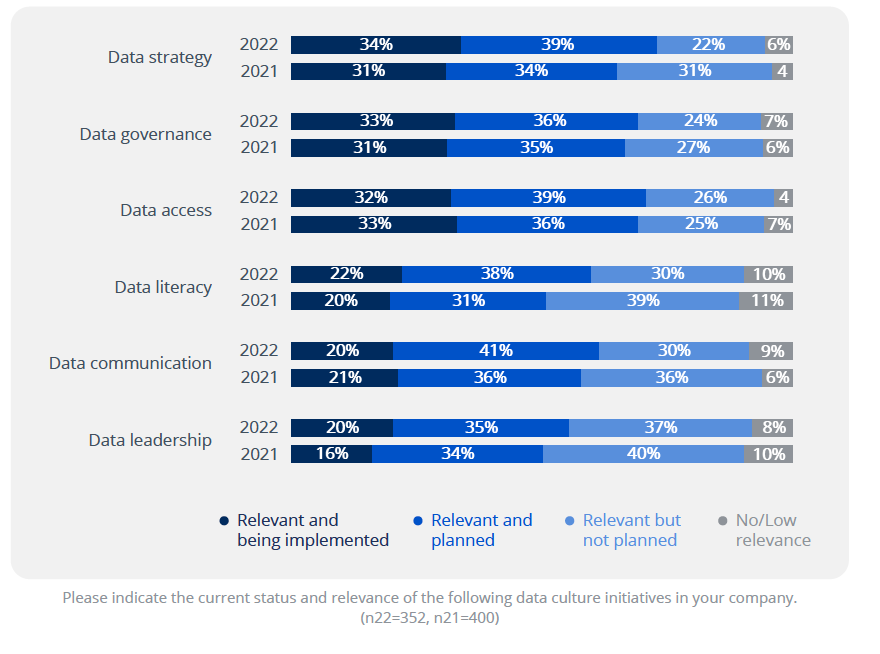
Overall, compared to 2021, the importance of data initiatives has increased in each of the 6 aspects of the BARC Data Culture Framework: Data strategy, Data Governance, Data access, Data literacy, Data communication, and Data leadership.

The most significant and the most implemented initiative impacting data culture was Data strategy, with 94% of respondents considering it to be relevant & 73 percent having already launched or planning to launch the initiative.

Closely related to data strategy is the data governance initiative. Governance is seen as an instrument for establishing a secure, consistent, and reliable data ecosystem that meets corporate & legal requirements. Indeed a third of respondents have already implemented governance initiatives and a further 36% have it planned.

Data leadership is also considered relevant in 92 percent of companies. However, only 20 percent have anything in place and 35 percent have implementations planned.

Current Status And Relevance Of Data Culture Initiatives Barc Data Culture Survey 23

Data leadership is dependent on the generation of leaders. BARC states in their survey “Strategies for Driving Adoption and Usage with BI and Analytics”, that a new generation of data-driven leaders was cited as the strongest driver of BI and analytics tool adoption and usage.

An interesting note from CxOs: 81% of those surveyed claim that data literacy initiatives have already been implemented or are planned, and the corresponding figure for data communication is 78 percent. However, employees in operational functions and data and analytics leaders and experts report less widespread activity – there is work to be done to convince top management that competence and communication are still nowhere near as far advanced as they think!

Data access initiatives have the highest relevance overall at 96% having already been implemented! Data literacy and data communication trail way behind, each with around 40 percent of participants not planning any initiatives in these areas.

The obstacles to overcome for data culture implementation

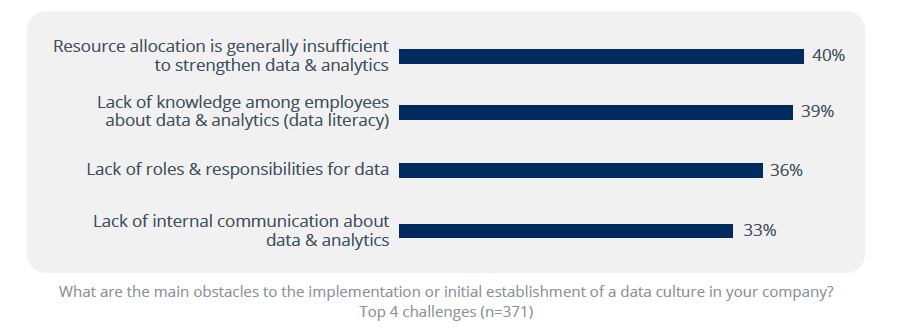
According to BARC, the top barriers to implementing data culture are the lack of resources, lack of knowledge, organization, and communication. They have consistently been the biggest challenges for data and analytics leaders for a long time. A particular concern is that many are prioritizing initiatives to improve data culture that do not directly address the biggest problems.

For instance, the lack of data literacy is the second most frequent challenge but tackling it is not a high priority for participating companies. Unlike data strategy, data governance, and data access, data literacy is one of the initiatives where a lot is planned but relatively little is done.

In fact, the prevailing opinion is that the purchase of specific data technology or software solves data problems. BARC states that this is not the case. For example, a data catalog without any organization (roles, responsibilities, processes) and active use by data consumers and producers will never be able to deliver the benefits it is designed for.

This also includes data leadership and communication: from the beginning, the goal should be to bring everyone along, empower them, and set an example of data-driven action. This requires creating the necessary space, starting with the development of a data strategy.

Main Obstacles For Data Culture Initiatives Barc Data Culture Survey 23

Learn more about the data culture trends by downloading the BARC Data Culture Survey

If you’re interested in learning more about the findings of BARC’s Data Culture survey 23 & the importance of democratizing data access, download the document for free!

By downloading the survey, get insights on:


  • The assessment of the data access philosophies,
  • The effects of the implementation of a data culture,
  • The challenges of implementing data access,
  • And much more.

* The sample was divided into ‘best-in-class’ and ‘laggards’ in order to identify differences in terms of the current data culture within organizations. This division was made based on the question “How would you rate your company’s data culture compared to your main competitors?”. Companies that have a much better data culture than their competitors are referred to as ‘best-in-class’, while those who have a slightly or much worse data culture than their competitors are classed as ‘laggards’.

The data-driven decision-making trends in 2022 – BARC Data Culture Survey 23

The data-driven decision-making trends in 2022 – BARC Data Culture Survey 23

Zeenea is a proud sponsor of BARC’s Data Culture Survey 23. Get your free copy here.

In last year’s BARC Data Culture Survey 22, “data access” was selected as the most relevant aspect of BARC’s ‘Data Culture Framework’. Therefore, this year, BARC examined the current status, experiences, and plans of companies with regard to their efforts to create a positive data culture with a special emphasis on ‘data access’.

The study was based on the findings of a worldwide online survey conducted in July and August 2022. The survey was promoted within the BARC panel, as well as via websites and newsletter distribution lists. A total of 384 people took part, representing a variety of different roles, industries, and company sizes.

In this article, discover the current status of data-driven decision-making of BARC’s Data Culture Survey 23.

Data-driven decision making versus gut feeling

74% of “best-in-class”* companies rely on data-driven decision-making

Over the years, companies have relied on data & analytics for decision-making rather than purely on experience or gut feeling. However, while the share of companies making decisions solely based on experience is decreasing, it isn’t completely off the radar. In fact, according to the BARC Data Culture Survey 23, half of the companies surveyed said their decision-making process was based on a mixture of data and gut feeling. In particular, there was a massive shift towards data-driven decision-making in 2021, probably driven by external factors such as the COVID-19 crisis.

The value of data for decision-making thus remains clear to most organizations, especially in the current economic & political environment. The challenge was more related to being able to bring value to data at a reasonable cost.

It is noteworthy that 74% of “best-in-class”* companies completely rely on data to make decisions. If we look closely at the numbers below, this reveals a significant difference compared to the average of all participating companies, of which only 32% make decisions purely based on data.

Are Decisions In Your Company Based On Data Or Gut Feeling

The most data-driven departments of a company

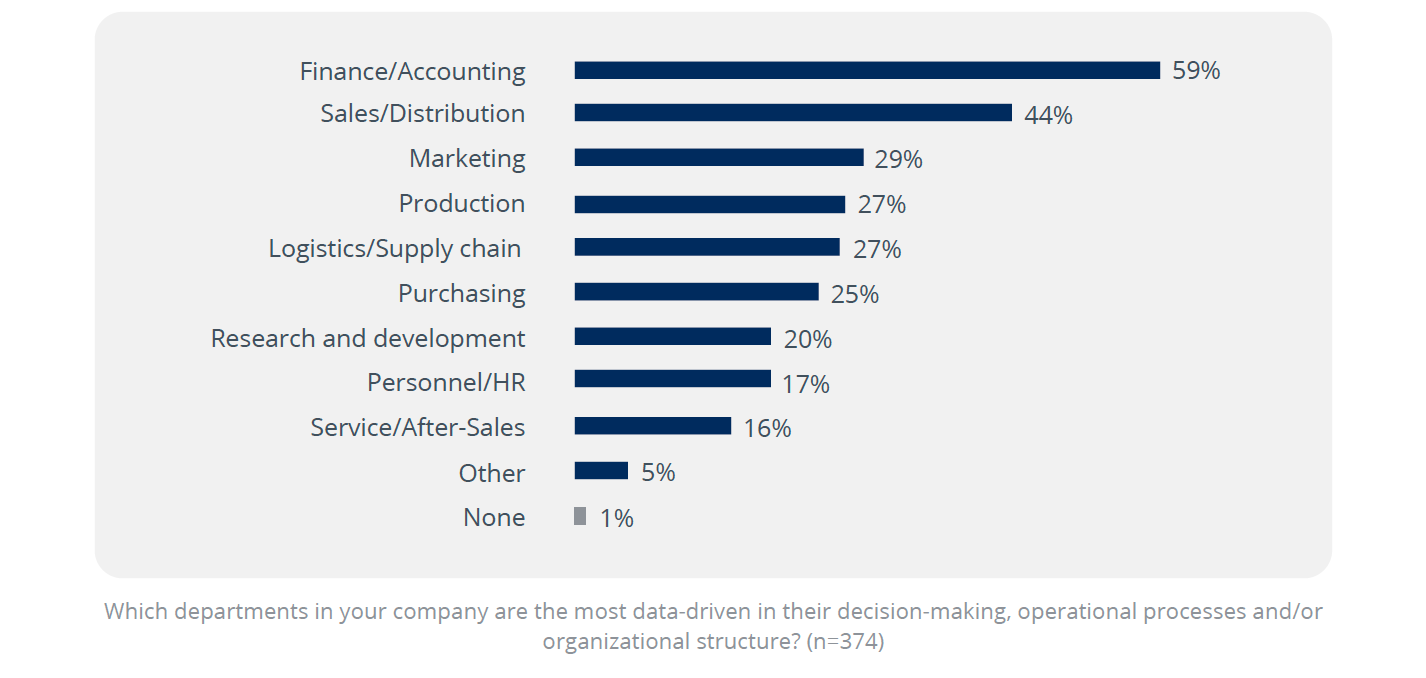
When asked about the departments they considered to be the most data-driven, 59% of companies responded that it was their finance/accounting department, followed by their sales & distribution department at 44%. These answers were expected, as these areas have the highest BI and analytics tools usage. BARC also observed that the Logistics/Supply Chain department as well as the Production department were a lot higher than expected. This increase is the result of the rise of IoT technologies in recent years.
Most Data Driven Departments In Their Decision Making Barc Data Culture Survey 23

Data-driven decision support should be at all levels of the company

Data knowledge is key to the successful use of data & analytics – 83% of companies confirm that they see data/information as an asset, but only half of the companies surveyed use data as a major source of revenue. Indeed, 74% of users identify data knowledge as the collecting, linking, and analyzing of metadata.

Metadata provides contextual information necessary to help data users find, understand, and trust their data. However, the study shows that few companies currently invest in technologies that help leverage metadata – whereas 95% of the “best-in-class”* companies acknowledge the importance of investing in such technologies.

The use of data at various levels of decision-making is noteworthy: At both operational and tactical levels in business units, 39% of survey respondents claim that decisions are not made on the basis of data. This is quite a high figure – data-driven decision support should be in place throughout the company at all levels.

Data Culture Agree Or Disagree Barc Survey 23

Liberalize data access & empower your data users through a strong data culture

If you’re interested in learning more about the findings of BARC’s Data Culture survey 23 & the importance of democratizing data access, download the document for free!

By downloading the survey, get insights on:


  • The assessment of the data access philosophies,
  • The effects of the implementation of a data culture,
  • The challenges of implementing data access,
  • And much more.

* The sample was divided into ‘best-in-class’ and ‘laggards’ in order to identify differences in terms of the current data culture within organizations. This division was made based on the question “How would you rate your company’s data culture compared to your main competitors?”. Companies that have a much better data culture than their competitors are referred to as ‘best-in-class’, while those who have a slightly or much worse data culture than their competitors are classed as ‘laggards’.

How to liberalize data access & empower data users – Check out BARC’s Data Culture Survey 23

How to liberalize data access & empower data users – Check out BARC’s Data Culture Survey 23

Zeenea is a proud sponsor of BARC’s Data Culture Survey 23. Get your free copy here.

Data culture eats data strategy for breakfast” is a powerful saying among data & analytics managers that underlines the importance of aligning data strategy & organizational culture for operational success. Indeed, data culture is a people matter. Data becomes a high-value asset when it is shared and available to everyone in an organization.

In last year’s BARC Data Culture Survey 22, “data access” was selected as the most relevant aspect of BARC’s ‘Data Culture Framework’. Therefore, this year, BARC examined the current status, experiences, and plans of companies with regard to their efforts to create a positive data culture with a special emphasis on ‘data access’. In this article, discover the 8 key findings of BARC’s Data Culture Survey 23.

Management Survey: 8 data culture findings in data-driven companies

1 – Decisions are made based on a mixture of data & gut feeling

Following an increase in 2021, the proportion of companies making primarily data-driven decisions has remained stable this year with 50 percent stating that they generally base their decisions on a combination of data and gut feeling.

2 – Data knowledge is essential to data & analytics

Almost three-quarters of respondents state that they have recognized the need to invest in ways to access, link, and understand metadata. However, some of the tools used are not very widespread yet.

3 – Data culture is beneficial

Almost half of the companies surveyed count improved decision-making among the goals they have achieved, and more than a third have achieved continuous process improvements and cost reductions through the use of data. However, expectations are much higher and more diverse.

4 – Data literacy, leadership, and communication need a boost

According to survey participants, data leadership, data communication, and data literacy initiatives have only been launched by around 20 percent. The CxO perspective is quite different: 81 percent of CxOs claim that data literacy is already in place or planned, and 78 percent say the same for data communication.

5 – Companies seem to focus on the wrong actions

The biggest reported obstacles to implementing a data culture are a lack of resources, a lack of knowledge, a lack of roles and responsibilities, and inadequate communication – but it is precisely these obstacles that are the least frequently addressed in concrete initiatives.

6 – Most companies believe in the ‘right to know’ approach

Companies today still predominantly follow the ‘need to know’ principle, which means data access is only granted on request. 59 percent of respondents see greater advantages in the more liberal ‘right to know’ approach.

7 – The conditions for the democratization of data access are not yet in place

The biggest challenges to liberalizing data access are a lack of data knowledge on the part of users and enabling simple access methods. Many of the conditions for better data access must therefore be created first.

8 – True data-driven companies rely on modern concepts, technologies, and metadata

Best-in-class companies use technologies and concepts beyond ‘classic’ business intelligence tools. These include tools for metadata management (e.g., data catalogs, data intelligence platforms), tools for data virtualization, organizational concepts (e.g., data mesh), and architectural concepts and principles such as data fabric.

Learn how to liberalize data access & empower your data users

If you’re interested in learning more about the findings of the Data Culture survey, download the document for free!

By downloading the survey, get insights on:

  • The assessment of the data access philosophies,
  • The different technologies used,
  • The effects of the implementation of a data culture,
  • The challenges of implementing data access,
  • And much more.

The guide to becoming data-driven by Airbnb

The guide to becoming data-driven by Airbnb

Since 2008, Airbnb has grown tremendously with over 6 million listings and 4 million hosts worldwide – becoming a viable alternative to hotels.

With the collection of extensive information on hosts, guests, the length of stay, the destinations, etc., Airbnb produces colossal volumes of data every day! In order to be able to clean, process, manage, and analyze all this data, the leader in accommodation had to implement a solid and rigid data culture in its organization.

In this article, discover the best practices implemented at Airbnb to become a data-driven company – all based on the intervention of Claire Lebarz, Head of Data Science, at the Big Data & AI Paris 2022.

The 3 levels of maturity of a data organization according to Airbnb

The term data-driven is very well-known and commonly used to describe a company that makes strategic decisions based on the analysis and interpretation of data. In a truly data-driven company, all employees and leaders harness data naturally and integrate it into their daily tasks.

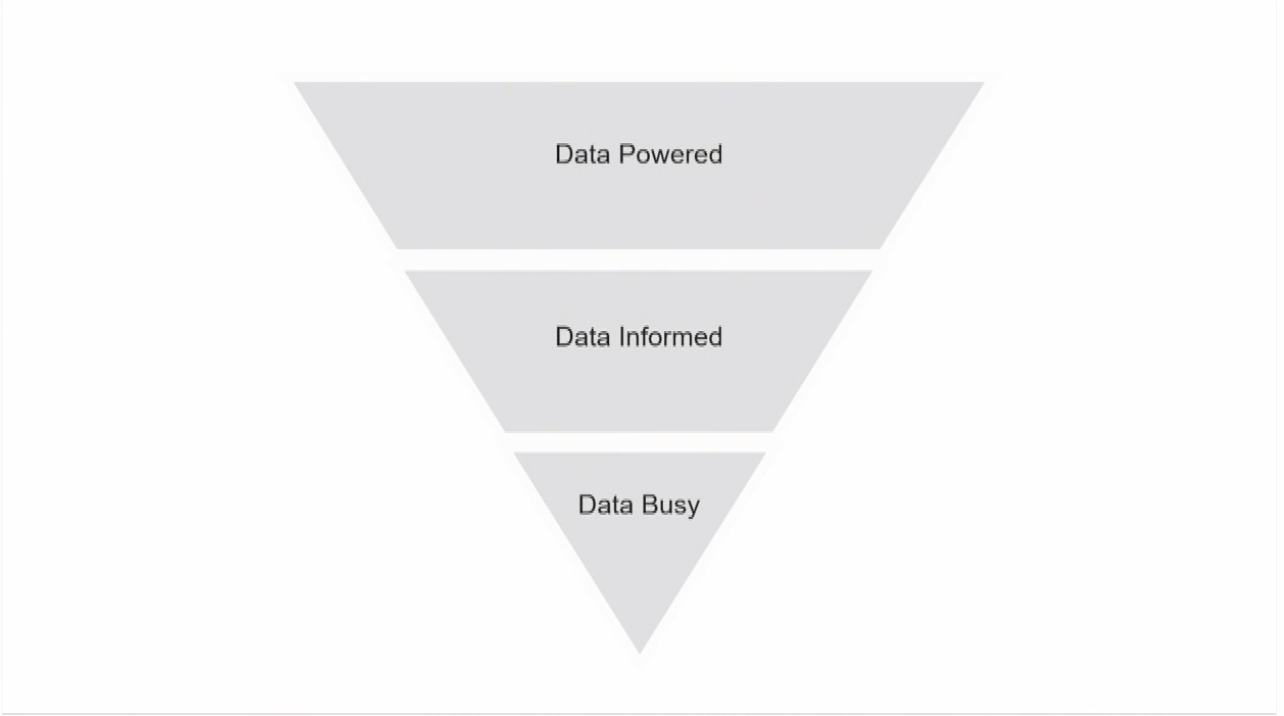
According to Claire Lebarz, however, the term “data-driven” is often overused: “I prefer to think in terms of three levels of maturity that characterize a data organization: Data Busy, Data Informed, Data Powered.”

Levels Of Maturity Data Driven

At the “Data Busy” level, a company has implemented data-centric people such as Data Analysts, Data Scientists, or Data Engineers in the organization. However, the analysis time is not quick enough, or there is no return on investment for the Data Scientists.

“At this level, there aren’t any rules in place about the quality of the data, the data is not trusted. Or it represents a bottleneck for the organization,” explains Claire.

At the “Data-Informed” level, the organization has implemented data governance and strategic decisions are increasingly based on the company’s KPIs and metrics rather than on the instincts of top management.

Finally, at the “Data-Powered” level, the highest level of the maturity matrix, data is on the critical line of the organization and becomes a key driver for business growth.

“Above all, data is no longer reserved for a group of data experts but for the entire organization – all employees are in tune with data,” explains the Head of Data Science.

The 6 steps to becoming data-driven according to Airbnb

Step 1: The scientific method

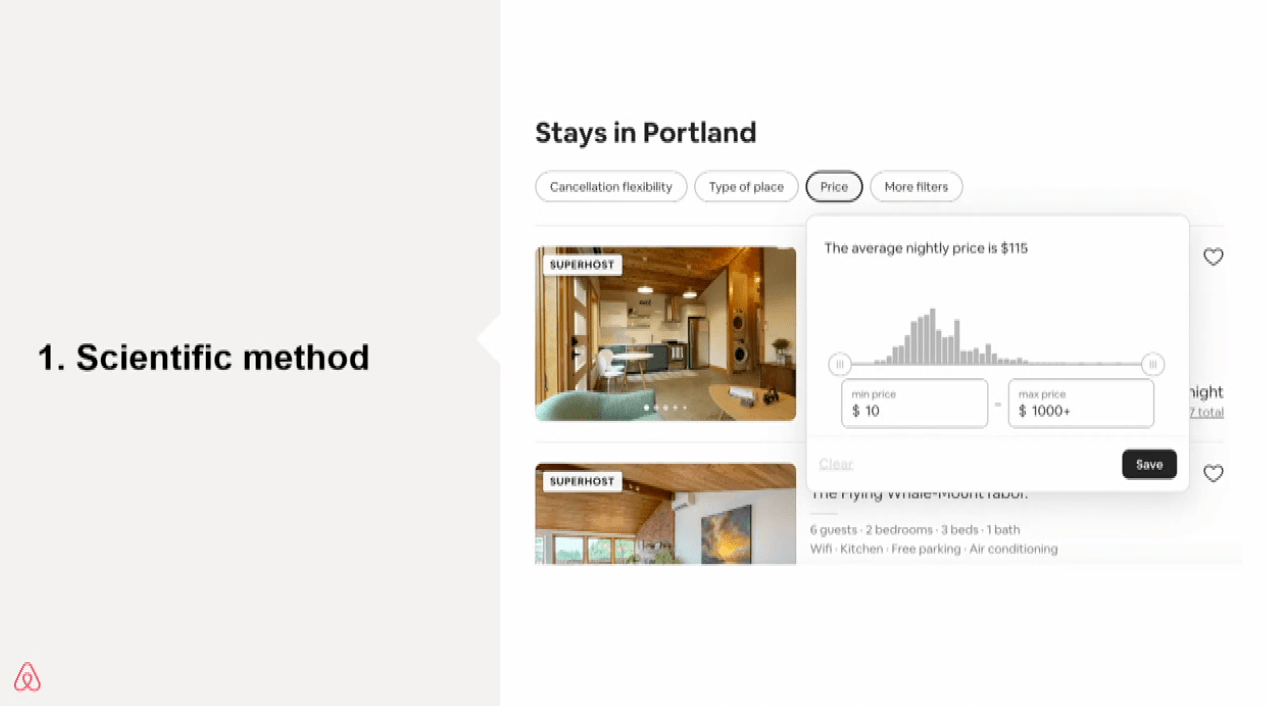
In ‘Data Science’, there is above all ‘Science’, explains Claire. So the first step is to take ownership of the scientific approach in the organization. “The idea is not to build a big R&D team, but rather to put on paper all the hypotheses we operate with and find ways to validate them or not.”

Scientific Method Airbnb

This approach implies testing, testing, and… more testing! And one of these levers is through A/B Testing. The Head of Data Science explains that it was crucial for Airbnb during the COVID-19 crisis to think about different assumptions about the world of today and that of tomorrow to make the right strategic pivots for the company.

One example that highlights the importance of A/B testing at Airbnb is the implementation of a maximum and minimum price filtering system on its booking site. Indeed, Claire explains that user experience feedback was better when travelers could indicate their maximum budget to book a stay. Without this little addition, travelers spent a lot of time on average listings and decided not to book.

Step 2: Strategic team alignment

For Claire L., setting up OKRs (Objectives & Key Results) is essential to align the different teams internally. Indeed, the data teams of an organization often tend to focus only on their own data metrics. Yet, it is imperative to put in place common company objectives to truly infuse a data culture in the company: “strategy must come before metrics.”

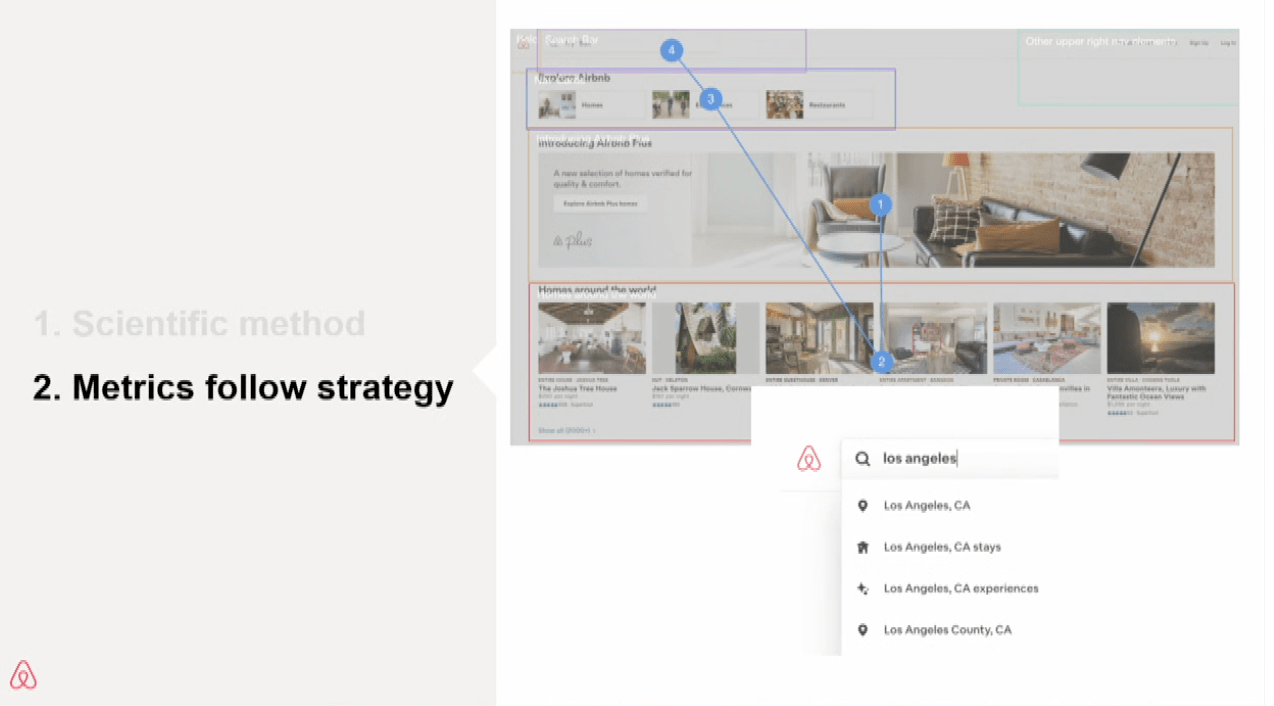
And the global leader in short-term rental experienced a lack of alignment. In the example below, we can see the negative consequences of this on the Airbnb site’s search experience in 2017. In this illustration, the query “los angeles” was yielding results in multiple categories without really making sense to the user.

Metrics Okrs Airbnb

Each team here was responsible for a decorrelated KPI. The “experience” team was responsible for company objectives to suggest things to do in the city, while another team was responsible for the cities closest to the search, etc. All were pushing multiple pieces of information to increase their own performance and drive traffic to their section of the website.

Users would get lost and end up not booking anything because the teams weren’t pulling in the same direction!

Step 3: Measuring uncertainty

For Claire L., “Uncertainty is inherent in running a business and making decisions.” Sometimes the best analysis does not equal the best decision. We need to have organizational discussions, such as: What level of confidence do we need to make decisions? What signals do we need to consider to change decisions?

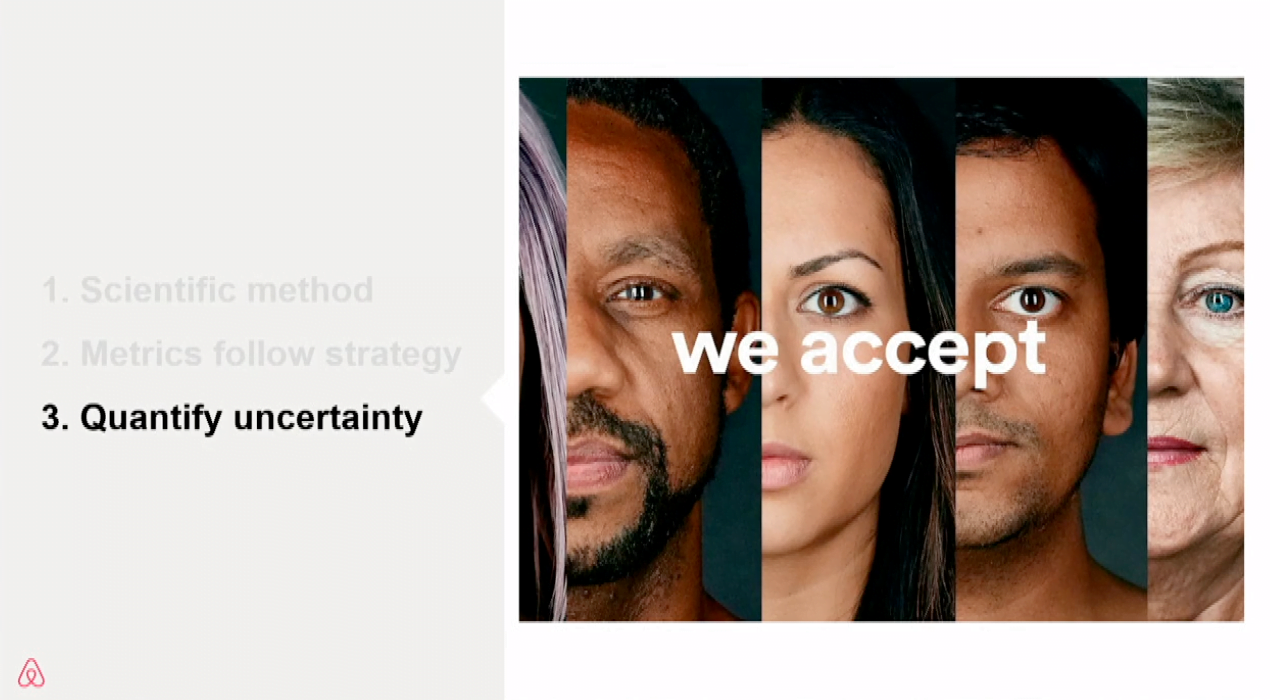
In the context of OKRs, there is often a temptation to avoid initiatives whose ROI is difficult to measure. However, just because a metric is difficult to measure does not mean that the initiative that depends on it is not the best one. An example that the Head of Data Science gives us is the branding campaigns carried out by Airbnb during the Super Bowl between 2017 and 2021.

Quantify Uncertainty Airbnb

“Branding campaigns are the hardest to measure, you can almost never know their ROI. But given our indirect results, building a great branding strategy and moving away from reliance on paid channels like SEM, was perhaps the best marketing strategy to boost organic and direct traffic.”

Step 4: Centralized governance

Governance, according to Claire L., must be centralized. Indeed, she noticed at Airbnb that as soon as you decentralize the data teams, and they report to the business, you quickly lose the objectivity of the data in the company. She explains: “Data must be considered as a common asset in the organization, and it is essential to make investments centrally and at the highest level of the organization. Data should be managed as a product with the employees as the customers.

Indeed, Conway’s law also applies to data: “organizations that design systems inevitably tend to produce designs that are copies of their organization’s communication structure.” If applied to data, this law refers to the various departments in the organization creating their own tables, analytics, and features – based on their own definitions – that are not always aligned with those of other departments.

Step 5: The right communication

Claire L. shares one of the best decisions Airbnb has made – that of hiring Data Scientists who are not only very good technically, but also good at communicating. Indeed, the company grew very fast in 2017-2018. And to get familiar with how Airbnb works, you sometimes had to read between 15 and 20 analyses for Scientists or take a lot of time to educate yourself on the company’s positioning for design teams – all of which could quickly become costly.

So Airbnb changed its approach to analytics. Instead of making traditional memos that tend to get stale over time and need to be constantly updated, the company started building “living documents.” “We set up “states of knowledge”, aggregations of all the knowledge of a team on a subject – updated according to the frequency of research on a question” Claire details.

The Head of Data Science also explains the importance of communication during the COVID crisis. Since the Airbnb teams in San Francisco were no longer face-to-face, it became essential to work on new communication formats: “We observed a great deal of email and screen fatigue in general. So we looked for more effective ways to communicate, such as via podcast or video formats, so that our employees could get information away from their screens. We needed to simplify and make information available in a simple and visual way so that all employees can appropriate the data.”

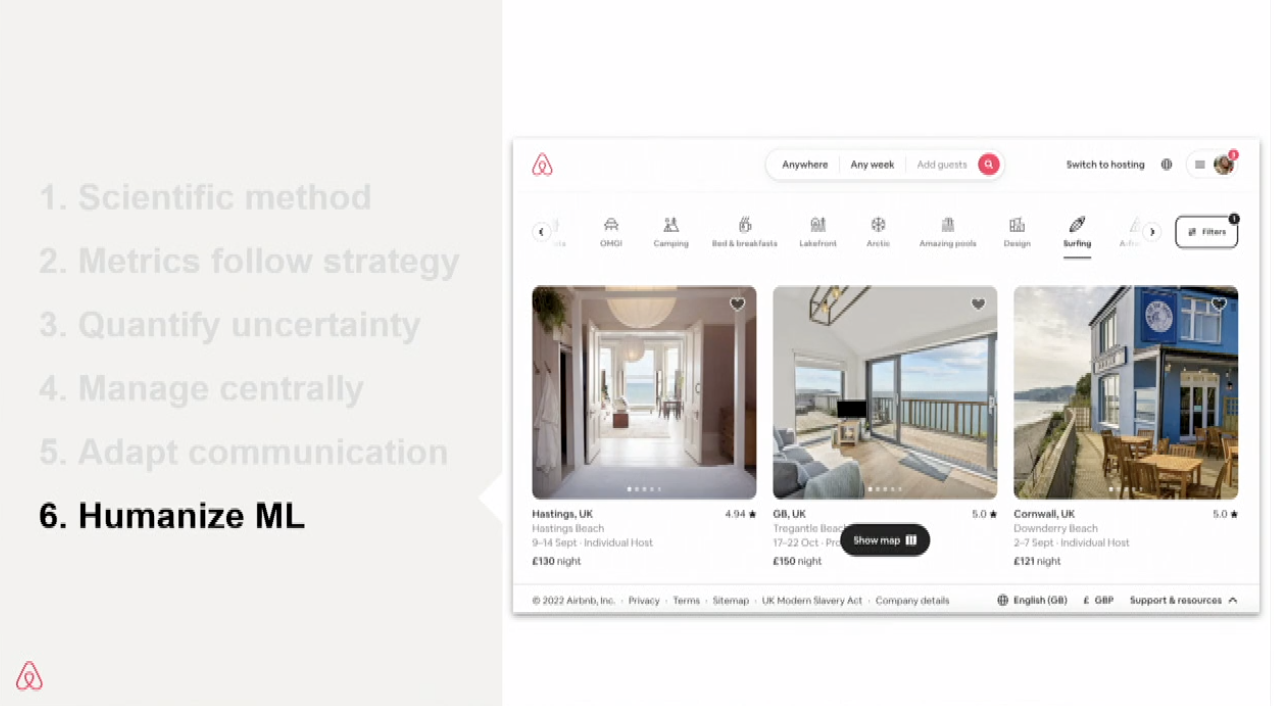
Step 6: A more human-like Machine Learning

Since its beginnings, Airbnb has used search-matching algorithms between guests and hosts. But it took time for the company to build them in volume – on the one hand, to improve the user experience – and on the other to help cross-functional teams get comfortable discussing modeling decisions.

Humanize Machine Learning Airbnb

Claire Lebarz explains that in order to have machine learning algorithms without defects, you have to look at the problem backwards: “Instead of saying that we have to solve a problem through automation and machine learning, we wanted to focus on the opposite: What kind of user experience do we want to create? And then go and inject machine learning where it makes sense to improve those processes.”

The addition of category-based searches on the Airbnb platform illustrates this. Indeed, it was about offering an alternative way to search for a place to stay: by asking the traveler what they would like to do. “Here we’re moving away from our basic model where we propose to enter dates and the place you want to go. Now we can ask you what you want to do or have, like surfing lessons, a nice beach view, or even a pool.”

These algorithms are labor-intensive because they depend on documentation provided by hosts. To avoid having to ask hosts several questions a week, it’s the machine learning that “searches” for this information and pulls it up into the right categories on the site via algorithms.

Conclusion: the 3 data-driven talents according to Airbnb

To ensure a true data culture, hiring the right talent is crucial. According to Claire, here are the three essential data roles of a data-driven enterprise:


  • Analytics Engineers: they are the guarantors of data governance and quality. They position themselves between Data Engineering and Analytics to focus on insights and questions.
  • Machine Learning Ops: this is a new profession that focuses on the operation and evolution of machine learning algorithms.
  • Data Product Managers: they are the ones who instill the way to manage data as a product and professionalize the data approach in the organization. They provide transparency on roadmaps, and new data features and they serve as a liaison with other functions.

“It is critical to bring these three emerging professions into the organization to truly become Data Powered!”

Data literacy: the foundation for effective data governance

Data literacy: the foundation for effective data governance

On September 28th and 29th, we attended several conferences during the Big Data & AI Paris 2021. One of these conferences particularly caught our attention around a very trendy topic: data literacy. In this article, we will present best practices for implementing data literacy that Jennifer Belissent, Analyst at Forrester and Data Analyst at Snowflake, shared during her presentation. She also detailed why this practice is essential for effective data governance.


The data-driven enterprise

It’s no secret that today, all companies want to become data-driven. And everyone is looking for data! Indeed, it is no longer reserved to a particular person or team, but to all departments of the organization. From reporting to predictive analytics, to the implementation of machine learning algorithms, data must be present in the company’s applications and processes to provide information directly for the organization’s strategic decision-making. 

To do this, Jennifer says: “Silos must be broken down throughout the company! We need to give access to internal data of course, but we must not neglect external data, such as data from suppliers, customers and partners. We use it and today we are even dependent on it.”


What is data literacy?

Data literacy is the ability to identify, collect, process, analyze, and interpret data in order to understand the transformations, processes, and behaviors it generates. 

However, many employees suffer from a lack of knowledge around data and associated analytics, because they do not recognize what data is and the value it brings to the company. And every employee has a role to play. For better data governance, a data literacy program must be established. 


The challenges of data governance

 The colossal amounts of data an organization generates must be managed and governed properly in order to extract a maximum value from them. Jennifer presents the three major challenges at Snowflake: 

  1. Data is everywhere: whether it’s in analytics systems, storage locations, or Excel files, it’s hard to know all the data in the company if it’s not shared.
  2. Data management is complex: it’s hard to manage all this data from various sources. Where is the data? What does it contain? Who owns it? The answers to these questions require centralized visibility and control.
  3. Security and governance are rigid: data security is very often linked to the organization’s data silos. To secure and govern this data, it is necessary to have a unified, consistent and flexible policy.

But that’s not all! There is a fourth challenge: the lack of data literacy.


The consequences of a lack of data literacy in an organization

To illustrate what data literacy is, Jennifer recounts to us an anecdote. In early 2020, during the first lockdown in France, Jennifer was talking to the Chief Data Officer at Sodexo. The CDO told Jennifer that during a data analysis related to their website, an interesting fact emerged: a peak in the purchase of sausages in the morning

This surprised the CDO who found this increase in sausage sales strange, knowing that “breakfast sausages” were not a usual breakfast for the French! 

Upon further investigation, the CDO discovered that this spike in sales coincided with Sodexo’s replacement of traditional point-of-sale cash registers with automated kiosks. These kiosks had buttons for each item to better manage orders. The problem was identified: the cashier in charge of these new kiosks had no idea what these buttons represented and was constantly pressing them, without knowing that they were actually capturing data! Fortunately, Sodexo had noticed this, otherwise the company would have ordered a huge stock of sausages…

Following this story, Jennifer says she conducted a qualitative study with Forrester asking three questions:

  1. Do you work with data?
  2. Are you comfortable with data?
  3. If not, what training would help you feel more comfortable with data?

The answers to these questions were surprising! In fact, Jennifer says Forrester thought the most important question in the study would be the last one. But it was actually the answers to the first question that surprised them: many of the people answered that they didn’t work with data at all because “they didn’t work with spreadsheets or calculations.” 

On the other hand, those who answered that they were comfortable with data had a big lack of trust with their colleagues: these people were the only ones who understood the data and therefore worried about the mistakes their collaborators might make. 

“So there were two major problems with data: getting useful and reliable data, but more importantly, most people in this study didn’t even know they were working with data!” says Jennifer. 


Lack of data literacy undermines data governance

The definition of data literacy, according to Jennifer, is someone who can read, understand, create and communicate data. But Jennifer doesn’t think that’s enough: “You also have to be able to recognize data. As we’ve seen, many people today don’t know what data is.”

For many, data governance is only associated with security. But in reality, governance spans the entire value chain and the entire life cycle of data! There are three pillars of data governance according to Jennifer:

  1. Know the data: understand, classify, track data and its use, know who owns it, know if it’s good quality, if it’s sensitive, etc.
  2. Protect data: Secure sensitive data with access controls based on internal policies and external regulations.
  3. Liberate data: convey the potential of data and enable teams to share it.

And around these three pillars comes data literacy! Data governance will be improved through better data literacy.

big-data-paris-data-literacy-article-zeenea-2

Best practices in data literacy

The implementation of a data literacy program should not be reserved to experts, and should even start at the bottom of the pyramid! This starts with the onboarding process of a new employee, for example.

Jennifer suggests that companies wishing to become data-driven rely on a data literacy program that meets 4 objectives: 


      • Raise awareness: make all employees aware of what data is, its interest, the role of each person with regard to data and, above all, the value it brings to the company.
      • Improve understanding: those who are supposed to use data in the company are often afraid, and do not always understand it. It is therefore important to provide them with the right tools, help them ask the right questions and explain the logic of the analyses so that these users can make better decisions.
      • Enriching expertise: tThis means putting the best technical tools and practices in place, but it also means leveraging them.
      • Enable scaling: iIt is thanks to your company’s data experts that you will be able to enable scaling and therefore, help create a community and a data culture. It is important that these experts pass on their knowledge to the whole company.
big-data-paris-data-literacy-article-zeenea-3

To conclude, Jennifer shares one last analogy: “

For data-driven companies, data governance represents the traffic laws, and data literacy is the foundation.” 

Data strategy: how to break down data silos?

Data strategy: how to break down data silos?

Whether it comes from Product life cycles, marketing, or customer relations, data is omnipresent in the daily life of a company. Customers, suppliers, employees, partners… they all collect, analyze and exploit data in their own way.

The risk: the appearance of silos! Let’s discover why your data is siloed and how to put an end to it.

A company is made up of different professions that coordinate their actions to impose themselves on their market and generate profit. Each of these professions fulfill specific missions and collect data. Marketing, sales, customer success teams, communication…all of these entities act on a daily basis and base their actions on their own data.

The problem is that, over the course of his or her career, a customer will generate a certain amount of information. 

A simple lead, then becomes a prospect , who then becomes a customer…the same person may have different taxonomies based on which part of the business is analyzing this data.

This reality is what we call a data silo. In other words, data is poorly or never shared and therefore too often untapped. 

In a study by IDC entitled “The Data-Forward Enterprise” published in December 2020, 46% of French companies forecast a 40% annual growth in the volume of data to be processed over the next two years. 

Nearly 8 out of 10 companies consider data governance to be essential. However, only 11% of them believe they are getting the most out of their data. The most common reason for this is data silos.


What are the major consequences of data silos?

Among the frequent problems linked to data silos, we find first and foremost the problem of duplicated data. Since data is used blindly by the business, what could be more natural?

These duplicates have unfortunate consequences. They distort the knowledge you can have of your products or your customers. This biased, imperfect information often leads to imprecise or even erroneous decisions.

Duplicated data also take up unnecessary space on your servers. Storage space that represents an additional cost for your company! Beyond the impact of data silos on your company’s decisions, strategies, or finances, there is also the organizational deficit.

When your data is in silos, your teams can’t collaborate effectively because they don’t even know they’re mining the same soil! 

At a time where collective intelligence is a cardinal value, this is undoubtedly the most harmful event caused by data silos.   


Why does your company suffer from data silos?

There are many causes for siloed data. Most often, they are associated with the history of your information systems. Over the years, these systems were built as a patchwork for business applications that were not always designed with interoperability in mind. 

Moreover, a company is like a living organism. It welcomes new employees when others leave. In everyday life, spreading data culture throughout the workforce is a challenge! Finally, there is the place of data in the key processes of organizations. 

Today data is central. But when you go back 5 to 10 years ago, it was much less so. Now that you know that you are suffering from data silos, you need to take action. 

How do you get rid of data silos?

To get started on the road to eradicating data silos, you need to proceed methodically.

Start by recognizing that the process will inevitably take some time. The prerequisite is a creating a detailed mapping of all your databases and information systems. These can be produced by different tools and solutions such as emails, CRMs, various spreadsheets, financial documents, customer invoices, etc.

It is also necessary to start by identifying all your data sources in order to centralize them in a unique repository. To do this, you can for example create gaps between the silos by using specific connectors, also called APIs. The second option is to implement a platform on your information system that will centralize all the data

Working as a data aggregator, this platform will also consolidate data by tracking duplicates and keeping the most recent information. A Data Catalog Solution will prevent the reappearance of data silos once deployed. 

But beware, data quality, optimized circulation between departments, and coordinated use of data to improve performance is also a human project!

Sharing best practices, training, raising awareness – in a word, creating a data culture within the company – will be the key to eradicating data silos once and for all.

What are the ingredients for becoming a good Chief Data Officer in 2021?

What are the ingredients for becoming a good Chief Data Officer in 2021?

In a world where data is a major strategic asset, the Chief Data Officer is undeniably a key role for enterprises today. In our last article on CDOs, we discussed what exactly a Chief Data Officer is, and some of his or her key missions in an organization. Now more than ever, as a key player in managing data processes and usages, the CDO must have both technical and human capacities. Let’s take a look at how to be a good Chief Data Officer in 2021!

Pedagogy, support, empathy, vision… Here are some of the many characteristics that can be difficult to combine and reconcile on a daily basis.

And yet, because the role of the Chief Data Officer is as strategic as it is operational, he or she must not only be able to rely on their technical competences, but must also back his or her actions with the support of general management, all while remaining in contact with the business teams.

In order to meet these challenges, the CDO must therefore demonstrate both know-how and interpersonal skills. On the one hand, they must be able to propose new solutions and tools that allow the company to correctly analyze and exploit data, and on the other hand, know how to put data at the center of the company, in order to build a data culture and create links between the business and IT.


An increasingly wide scope of action

In their study entitled What are the roles and challenges of today’s Chief Data Officer (CDO)? – Focus on a key function of data-driven transformation (French), PwC defines the challenges CDOs are currently facing: 

“As data teams have been set up in large groups, the challenge now is shifting to get all the organization’s departments to work together. The acculturation of the company and the training of data teams are at the heart of the Chief Data Officer’s challenges.  This reality is reinforced by another observation: “The CDO must adapt to the transition from legacy systems to new data storage and analysis technologies, as well as to interfaces that respond to new uses (Cloud, Data Marketplaces, Data virtualization, IoT, chatbot, etc.). 

Finally, as the authors of the study’s summary pointed out, “with the growth in the number of use cases combining RPA and AI, the Chief Data Officer’s field of action is expanding”. Proof that the CDO’s missions are very critical for organizations. 

Another study conducted by IDC on behalf of Informatica and published in August 2020, revealed that 59% of CDOs surveyed report directly to a key company official, including the CEO. And the Chief Data Officer is directly involved in business performance. In fact, the same study points out that 80% of the Chief Data Officer’s KPIs are related to business objectives (operational efficiency, customer satisfaction, data protection, innovation, revenue and productivity).


The CDO’s challenges on a daily basis

The essential role of the Chief Data Officer is to build a relevant, high-performing, and valuable data pipeline, while putting together a team capable of bringing this valuable asset to life and transforming it into raw material that can be used by all business lines. 

This mission requires the Chief Data Officer to put together teams made up of competent and totally data-driven people. This is one of the major difficulties according to IDC. 71% of respondents have only four or fewer data managers, and 26% have none! The ability to recruit, surround oneself with and lead a data team is therefore a major challenge for the CDO. 

But it is not the only one. 

If we refer to the PwC study already mentioned above, it appears that for 70% of the Chief Data Officers questioned, data acculturation is implemented within their company. This acculturation is primarily achieved by setting up documentation on data that is shared and accessible to everyone, including non-IT profiles. This is another major challenge for CDOs, which is to act as a bridge between the IT players in the company and all of the business lines.  

“We see that this is accentuated by the scaling up of data projects, moving from initiatives on a limited perimeter – more in the form of a “Proof of Concept” (PoC) – to global projects involving multiple stakeholders,” PwC stated. The CDO is responsible for developing data processes to improve data quality and is present on all fronts. 

A true conductor who must know how to instill energy and dynamism to contribute to the economic recovery of companies in 2021!

Understanding the different Data Cultures

Understanding the different Data Cultures

Just like corporate or organizational culture, each enterprise that deals with data has its own data culture. We believe that what distinguishes Web Giants isn’t the structure of their governance, but the culture that irrigates and animates this organization.

At Zeenea, we believe in putting in place a Data Democracy. It refers to corporate culture, an open model where freedom rhymes with responsibility.

To better understand Data Democracy, it is necessary to compare it to other data cultures. Here are the main data cultures:


Data Anarchy

In this system, operational professions feel poorly served by their IT departments, and each one develops its own clandestine base (shadow IT) which serves their immediate interests while freeing them from all control regulations and conformity to standards. In 2019, this culture brings sizeable risks: data leaks, contravention of ethical regulations, service quality degradation, reinforcement of silos, etc.


Data Monarchy

This system translates to a very strong asymmetry in data access depending on the hierarchical position. Data, here, is very strictly controlled; its consolidation level is carefully aligned with the organizational structure, and its distribution is very selective.

This monarchical culture prevailed for a long time in Business Intelligence (BI) projects: data collected in data warehouses were carefully controlled, then consolidated in reports where access was reserved to a few select people who were close to decision-making bodies. This method promotes a “top-down” approach and willingly encourages a defensive strategy, where rules, restrictions, and regulations insulate data. Its main theoretical benefit is the almost infallible control over corporate data, but that translates into very limited access to data, only reserved to certain privileged groups.


Data Aristocracy

A Data Aristocracy is characterized by a more significant degree of freedom than in Data Monarchy, but which is solely reserved to a very select subset of the population, mainly expert profiles such as Data Engineers, Data Analysts, Data Scientists, etc. This aristocratic approach is often the one that brings the most successful data governance projects to the surface.

Such a culture can be favorable to more offensive strategies, as well as to heterogeneous one, combining top-down and bottom-up. However, it deprives the majority of employees access to data and thus, a certain number of possible innovations and valorizations.

Data Democracy

Data Democracy’s main objective is to make a company’s data widely accessible to the greatest number of people, if not to all. In practice, every employee is able to pull data values at any level. This freedom of access offers maximum opportunities to create value for the company; it provides each employee with the ability, at their level, to use all accessible and compatible resources within their needs in order to produce locally, and through a trickle effect, it will benefit the entire company.

This freedom only works if the regulations and the basic tools are implemented, and each employee is responsible for how they use their data. Therefore, the distribution of necessary and sufficient information is required to allow employees to make proper use of it while adhering to regulations.t

    Download our white paper “How does Data Democracy strengthen Agile Data Governance?”

    The democratic data culture presents an interesting challenge to balance: on one hand, you must ensure that the right to use data can truly be exercised, and on the other hand you must counterbalance this right with a certain number of duties. Find out how to construct a democratic data culture in our white paper, “How does Data Democracy strengthen Agile Data Governance?”.